

COLORADO OFFICE
414 14th St. Suite 300
Denver, CO 80202
(303) 308-1190
WYOMING OFFICE
259 South Center St. Suite 206
Casper, WY 82601
(307) 268-9890

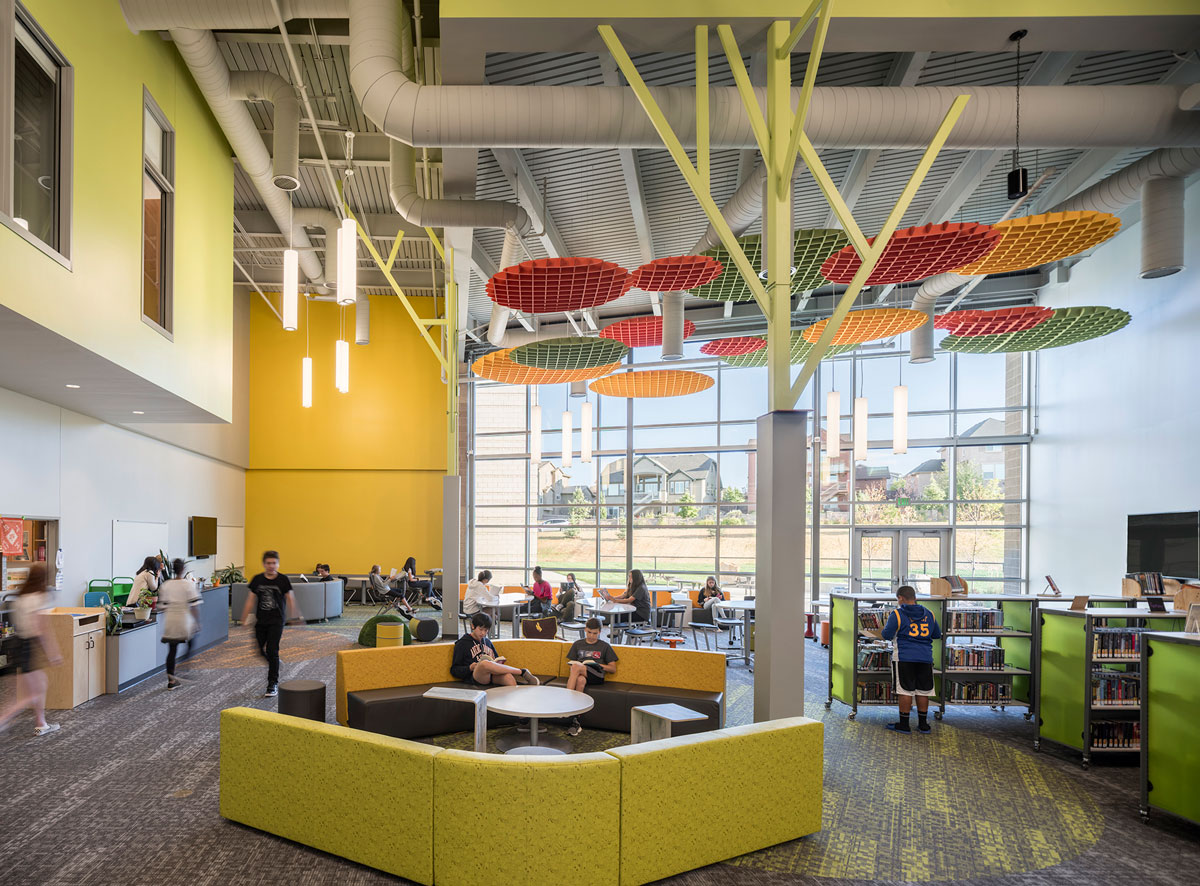
The WELL Building Standard is one of the leading frameworks for designing spaces that promote occupant wellness. In recent years, it has made steady inroads into Colorado, with roughly 30 projects achieving certification across the state.
Our team at MOA ARCHITECTURE, working alongside RTA Architects and BranchPattern, had the opportunity to incorporate WELL principles into the design of Chinook Trail Middle School, a 1,000-student middle school in Colorado Springs. Initially, the school was slated to become the first WELL Certified school in Colorado and one of only a handful nationwide.
WELL is structured to be integrated from the earliest stages of design, guiding decisions across air quality, water, nourishment, light, fitness, comfort, and mind. Throughout the process, these standards shaped every conversation with our client, Academy School District 20, and informed choices in classrooms, circulation, and gathering spaces. While achieving certification required a premium of roughly $125,000 — only 0.31% of the $41 million project budget — escalating construction costs eventually forced a reconsideration of priorities.
The budget challenges ultimately led to a difficult decision. Displacement ventilation, a key WELL feature that improves indoor air quality by reducing the spread of airborne contaminants, was eliminated in favor of a less costly mechanical system. Although this change removed the project’s path to formal WELL certification, nearly every other WELL principle remained embedded in the building design.
Today, Chinook Trail Middle School embodies the core intent of WELL through biophilic design, abundant daylight via solar tubes, and nature-inspired elements in circulation and gathering spaces. Even without the official certification, the school delivers a healthier and more thoughtful environment for students and staff.
Pursuing WELL on this project proved to be a transformative process. It introduced the district to a new set of considerations for school design, operations, and maintenance. It also reinforced the value of integrating wellness-focused design from the start, demonstrating that the benefits of WELL can extend far beyond a certificate on the wall.
COLORADO OFFICE
414 14th St. Suite 300
Denver, CO 80202
(303) 308-1190
WYOMING OFFICE
259 South Center St. Suite 206
Casper, WY 82601
(307) 268-9890