
COLORADO OFFICE
414 14th St. Suite 300
Denver, CO 80202
(303) 308-1190
WYOMING OFFICE
259 South Center St. Suite 206
Casper, WY 82601
(307) 268-9890


Over the past two decades, healthcare providers have declared war on wait time.
Study after study has shown that wait time has an outsized impact on patient satisfaction — and that dissatisfaction can trigger a domino effect, influencing employee morale, retention, and even perceived quality of care.
Recognizing wait time as a critical component of the care experience, providers are experimenting with new operational strategies to limit delays and reduce the negative impact when delays occur. One of the most visible casualties in this shift has been the traditional waiting room.
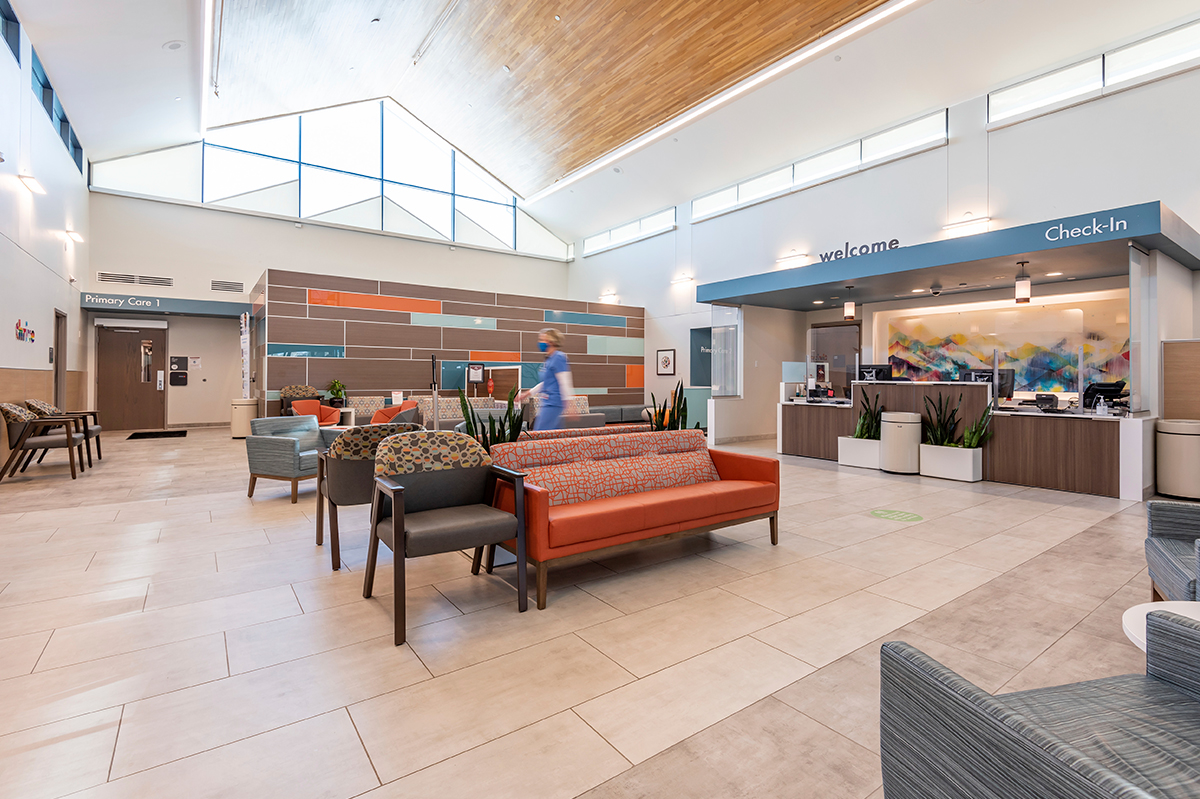
Many existing healthcare facilities still rely on large central waiting areas. Even thoughtfully designed lobbies — with abundant daylight, comfortable seating, and hospitality-inspired finishes — remain passive spaces. They do little to support the clinical workflow or reduce the anxiety that builds when patients sit and watch others being called ahead of them.
While operational improvements such as Lean process redesign and scheduling optimization are essential, there is also an architectural opportunity. Designers can help providers rethink patient flow and reconfigure existing facilities to better support efficiency and experience.
Through recent project experience with a regional not-for-profit health system in the Mountain West, MOA ARCHITECTURE explored an alternative model that minimizes the traditional waiting room altogether. Rather than directing all patients to a central lobby, the approach emphasizes quick check-in followed by movement closer to care delivery spaces. Patients either transition directly to exam rooms or to smaller, decentralized sub-waiting areas located within clinical pods.
This shift offers several advantages:
Just as importantly, it unlocks real estate.
Large centralized waiting rooms in existing clinics often represent underutilized square footage. By rethinking patient flow, that space can be reclaimed and repurposed for higher-value uses.
On a recent project, MOA ARCHITECTURE applied this strategy to an existing outpatient clinic. By reducing the size of the traditional waiting area and redistributing patient flow, the team reclaimed enough square footage to create a new behavioral health suite within the existing footprint. The provider was able to expand services and meet growing community demand — all without constructing a costly addition.
This type of transformation highlights a broader opportunity. As care delivery evolves, the most valuable space in a clinic is not where patients wait — it is where care happens.
Reimagining waiting areas is not simply about aesthetics or comfort. It is about aligning space with workflow, improving patient experience, and enabling future growth. For many existing facilities, the waiting room is no longer a necessity — it is an opportunity.
COLORADO OFFICE
414 14th St. Suite 300
Denver, CO 80202
(303) 308-1190
WYOMING OFFICE
259 South Center St. Suite 206
Casper, WY 82601
(307) 268-9890